

United Kingdom
Choose another country to see content specific to your location.


01 | What went well
Complaint. Now what?
Three years after the first IFRS 17 reporting cycle, the UK insurance industry has successfully transitioned to a fundamentally different accounting framework and the evidence from the first reporting cycles points to a number of important successes, beyond just compliance with the standard.
Based on preliminary evidence collected by the UK Endorsement Board (UKEB) as part of its post-implementation review capital market users of financial statements considered the quality of financial information provided by insurers to have improved compared with IFRS 4, with more detailed results. Internal processes were also improved as IFRS 17 fostered greater collaboration between actuarial and finance departments. This is significant considering these two functions had spent a generation working from different data, on different timetables and to different definitions of the same number.
However, achieving compliance was only the first stage. Three reporting cycles in, insurers are increasingly dealing with the consequences of IFRS 17 solutions built to achieve compliance rather than efficient decision-supporting outcomes. A recent IFRS 17 post implementation survey found 56% of insurers unable to fully leverage their IFRS 17 capabilities as a part of their decision-making process.i
56% of insurers are unable to fully leverage their IFRS 17 capabilities as a part of their decision-making process.
The complexity of IFRS 17 has introduced several inefficiencies including tedious manual processes, longer workday timelines and higher finance operating costs that prevent insurers from gaining decision-making insights from their financial results. For most insurers there is a clear need to drive financial transformation and optimisation across the business.
In this paper, Monocle highlights some of the inefficiencies that insurers are having to manage as part of their IFRS 17 reporting solutions and how best to address these issues.
Post-Implementation Review of IFRS 17 Insurance Contracts:
The UKEB’s Post-Implementation Review is intended to determine whether IFRS 17’s adoption in the UK has met its original technical, public-good, and true-and-fair-view criteria, determining implementation costs and any UK specific or wider issues for potential follow-up.
H1 2026: Research and consultation begin
H2 2026: Request for Information published with 90 day consultation window
H1 2027: Outreach based on RFI responses and the capital markets study
H2 2027: Draft and final PIR report presented to the UKEB Board
1 January 2028: Statutory deadline for completion
“Insurers are increasingly dealing with the consequences of IFRS 17 solutions built to achieve compliance rather than efficient decision-supporting outcomes.”
02 | Costs
Higher reporting costs are BAU
The UK Endorsement Board, as part of its initial consultation as part of its Post-Implementation Review of IFRS 17, highlighted UK insurers have experienced increases in ongoing reporting costs compared with IFRS 4, with implementation costs largely being absorbed into business-as-usual costs.
With insurers globally having spent an estimated $21-27 billion to implement the standardii, insurers must now continue to operate and maintain complex contractual service margin (CSM) calculation engines, new data repositories housing granular and intricate financial and actuarial data as well as related technology infrastructure. These systems also carry ongoing licensing, maintenance and support costs.
45% of one-off IFRS 17 implementation costs related to technology or data management. However, insurers are struggling to reap the efficiency and decision-making benefits of these investments.
This significant upfront operational cost to develop an IFRS 17 reporting solution that combines actuarial and finance data together into a cohesive solution, and automates feeds across valuation, administration and expense systems, has left many insurers struggling to overcome operational complexity due to:
Integrating systems end to end: Valuation, policy administration, expense and ledger platforms were never designed to interoperate, so insurers have had to build and maintain interfaces across differing data models and granularity.
Automating data and reporting processes: Manual workarounds persist at the handoffs between actuarial and finance, stretching workday reporting timelines.
Sourcing and assuring granular data: IFRS 17 requires cohort and cash flow level data that legacy systems either never captured or captured inconsistently. Insurers spend too much time on remediation and reconciliation.
Embedding governance and controls: Ownership of the numbers now spans actuarial, finance and IT, with extensive controls, review points and audit trails required across functions.
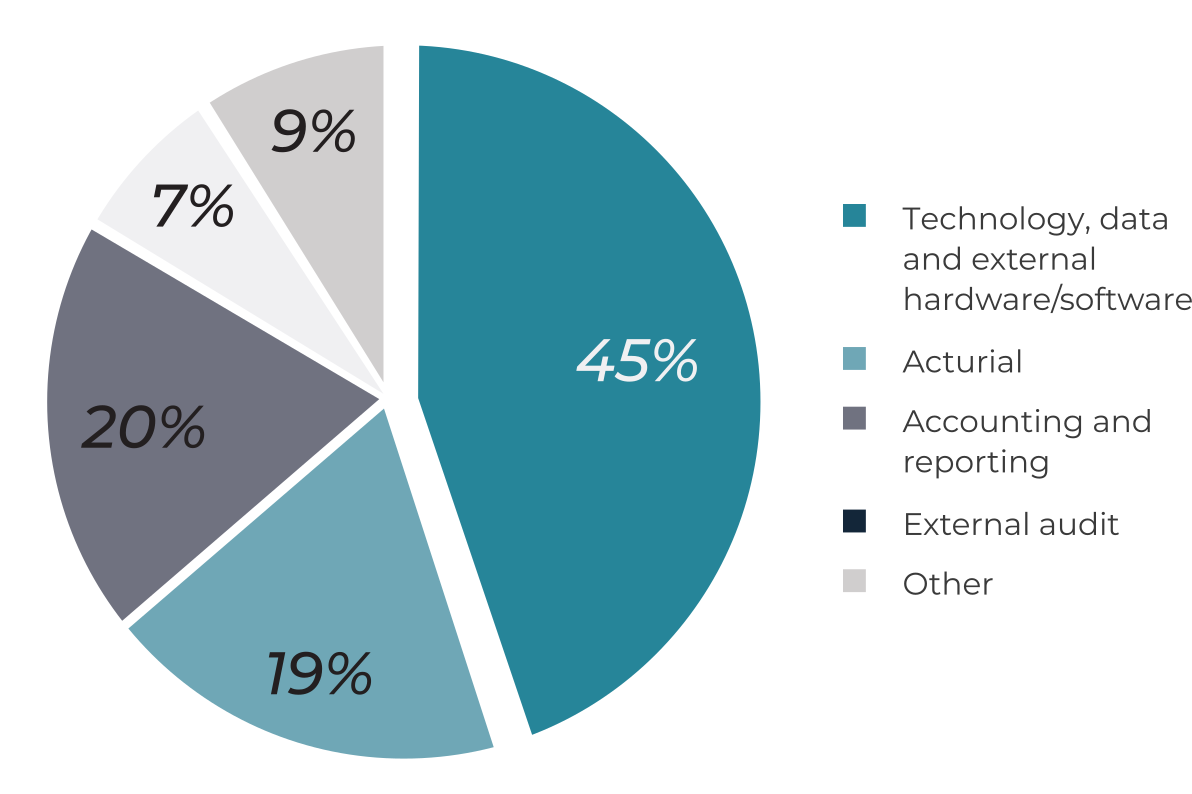
UK IFRS 17 Implementation Cost Estimates (2020)iii
03 | Comparability
Comparable on the surface, but not always underneath
One of the objectives of IFRS 17 was to improve transparency and comparability across insurers. Initial consultation concluded by the UK Endorsement Board highlighted enhanced understandability, transparency and a more consistent overall reporting framework amongst insurers globally, but the underlying measurement, judgement and presentation choices available to insurers means that comparability remains imperfect.iv In the same consultation, stakeholders identified the number of accounting policy choices and available interpretations under IFRS 17 as contributing to a relative lack of comparability.
Disclosures under IFRS 17 exhibit material inconsistencies across insurers, most notably:
CSM run-off: Reported gross/net of interest accretion with varying and sometimes broad time bands at horizon
Risk adjustment disclosures: Where insurers apply differing perimeters of diversification (ranging from group-level recognition to explicit exclusion of diversification benefits arising across group entities)
Return and leverage metrics: With different approaches to calculate these metrics on a CSM-adjusted basis
Discount rates: With only a portion of insurers disclosing the illiquidity premium separately
OCI option for economics: Applied by some insurers but not by others, decreasing P&L comparability
These are largely the result of accounting policy choices and permitted interpretations within IFRS 17. However, they demonstrate that compliance with the same accounting standard does not necessarily result in identical or easily comparable measurement or disclosure practices.
04 | Data Management
Data is getting in the way of explainability
Comparability has also led to a significant increase in disclosure with financial statements becoming longer and more detailed. This increase in information makes the capability to explain results more complicated and intricate, but ultimately a powerful tool for decision making if insurers are able to rapidly drill down into its data and understand the drivers of their financial results.
However, the challenge for insurers is not only to calculate the correct numbers, but to demonstrate efficiently and repeatably how it was produced, and to explain how it will move. A published CSM, loss component or loss recovery component balance is not simply an accounting output. It is the product of actuarial assumptions, model calculations, data movements, contractual groupings, accounting treatments and the controls applied over each of these.
This is where traceability and data quality become as important as accuracy. A reporting process that produces the right answer but requires significant manual investigation to explain the answer can still create substantial operational and audit costs. When postings are driven by complex calculations such as loss offsetting and allocation of any loss component, a thorough understanding of the upstream processes and reinsurance relationships is required to adequately explain any movement.
Data lineage provides a trace of where each metric comes from and the key data points driving it
Data quality provides confidence in the completeness, accuracy and timeliness of these metrics and data points
For insurers, investing in strategic solutions to identify, map, and embed enterprise data lineage, as well as implementing robust data quality rules and systems, can enable a more accurate and confident understanding of how their results are calculated.
“A reporting process that produces the right answer but requires significant manual investigation to explain the answer can still create substantial operational and audit costs.”
Another cost that has escalated is audit fees due to the significant increase in time and effort to audit IFRS 17 disclosures and the underlying data, models, controls and systems. Preparers participating in the original UKEB’s survey specifically identified an expected permanent increase in audit fees associated with auditing IFRS 17 disclosures and the supporting systems and data. Comprehensive data lineage and assured data quality assists insurers to easily and quickly unpack and evidence their data processes to speed up audits.
05 | Optimisation and Enhancement
From compliance to operational effeciency
Many insurers now have sophisticated solutions capable of performing the calculations required by IFRS 17. The challenge is that the overall reporting process can still contain manual reconciliations, spreadsheet-based adjustments, data movements and control activities between those systems. When catering for a host of idiosyncrasies (different schemes and products, multiple model types, complex expense attribution allocations, different grains of accounting data, and funds withheld structures) tactical approaches and overlays were generally required, to some extent, to go live. However, the longer these tactical interventions in the process persist, the more overhead and inefficiency build on top and embeds these tactical approaches into the work-day timetable.
In markets like Australia and New Zealand, less than 10% of insurer’s had a fully automated IFRS 17 solution with manual processes and data transformations two of the most significant operational challenges.v In Monocle’s experience, these finding hold relatively true across Europe, the United Kingdom and South Africa. These manual processes tie up experienced individuals in performing and reviewing activities, create dependencies on institutional knowledge, and slow the response when a number changes or an auditor requests supporting evidence.
“Tactical approaches and overlays were generally required, to some extent, to go live.”
The starting point is therefore to review the existing IFRS 17 data architecture to remove manual intervention, fragmented data sets and points of problematic reconciliation. Enforcing the IFRS 17 common data model and taxonomy will also ensure fragmented data sets are standardised and integrated at source rather than reconciled after the fact. From there, recurring manual interventions can be identified and assessed for automation, with controls, approvals and audit evidence embedded.
Furthermore, specialised AI and automation tooling can then perform reconciliations, data quality controls and remediation, lineage capture and the drafting of reporting commentary and analysis, with review and sign-off retained where judgement applies. The result is a reporting process that depends far less on spreadsheets, manual reconciliations and individual knowledge, and that frees finance and actuarial teams to spend their time on analysis and interpretation rather than on producing and correcting numbers. This refined process can then be more easily integrated with capital and liquidity processes and drive a wider balance sheet harmonisation initiative.
06 | How Monocle can assist
Creating an efficient reporting capability
Most insurers can now produce compliant IFRS 17 numbers. The next stage of maturity is not about producing the numbers. It is about a reporting process that is efficient, controlled, traceable and able to withstand increasing scrutiny, including the additional audit effort.
Monocle sits at the intersection of technical data management and insurance reporting. Having assisted multiple international insurers to implement IFRS 17, Monocle is critically positioned to understand and optimise the tactical solutions that started as a necessity at go-live but have since become a nuisance.
The objective is not to replace the actuarial and accounting expertise at the heart of IFRS 17, but to make everything around it faster, cleaner and easier to evidence by enhancing:
Data lineage and quality
Map the end-to-end flow of IFRS 17 data, identifying where information is transformed, adjusted or manually intervened with between source systems and the reported result.
Identify and remediate data inconsistencies and gaps to ensure accuracy, validity and completeness of data through controls, reconciliations and data quality ownership.
Embed data governance across finance, actuarial, product and supporting teams, so that every data item has a clear owner and a defined standard of maintenance and control.
Process mapping and transformation
Map individual activities, dependencies and hand-offs, exposing where time is lost and where steps can be simplified, standardised or automated to ensure a more predictable reporting cycle.
Automation of manual processes
Identify recurring manual interventions and assess which can be automated, with controls, approvals and audit evidence embedded in the process rather than bolted on afterwards.
Implement and embed specialised AI and RPA tools to automate reconciliations, data quality controls and remediation, reporting commentary and analysis and data lineage.
Data management and architecture
Design, develop and enhance IFRS 17 data architectures as well as define and enforce a common data model and data taxonomy to prioritise standardisation and integration of fragmented data sets to improve IFRS 17 reporting efficiency.
What’s the latest with Monocle
We have all the latest industry insights
Explore trending topics in the banking and insurance industries

The Regulatory Reporting Vendor Landscape:
The role of Vendors, Market Dynamics & What it Means for Your Programme.
Read more