
United Kingdom
Choose another country to see content specific to your location.


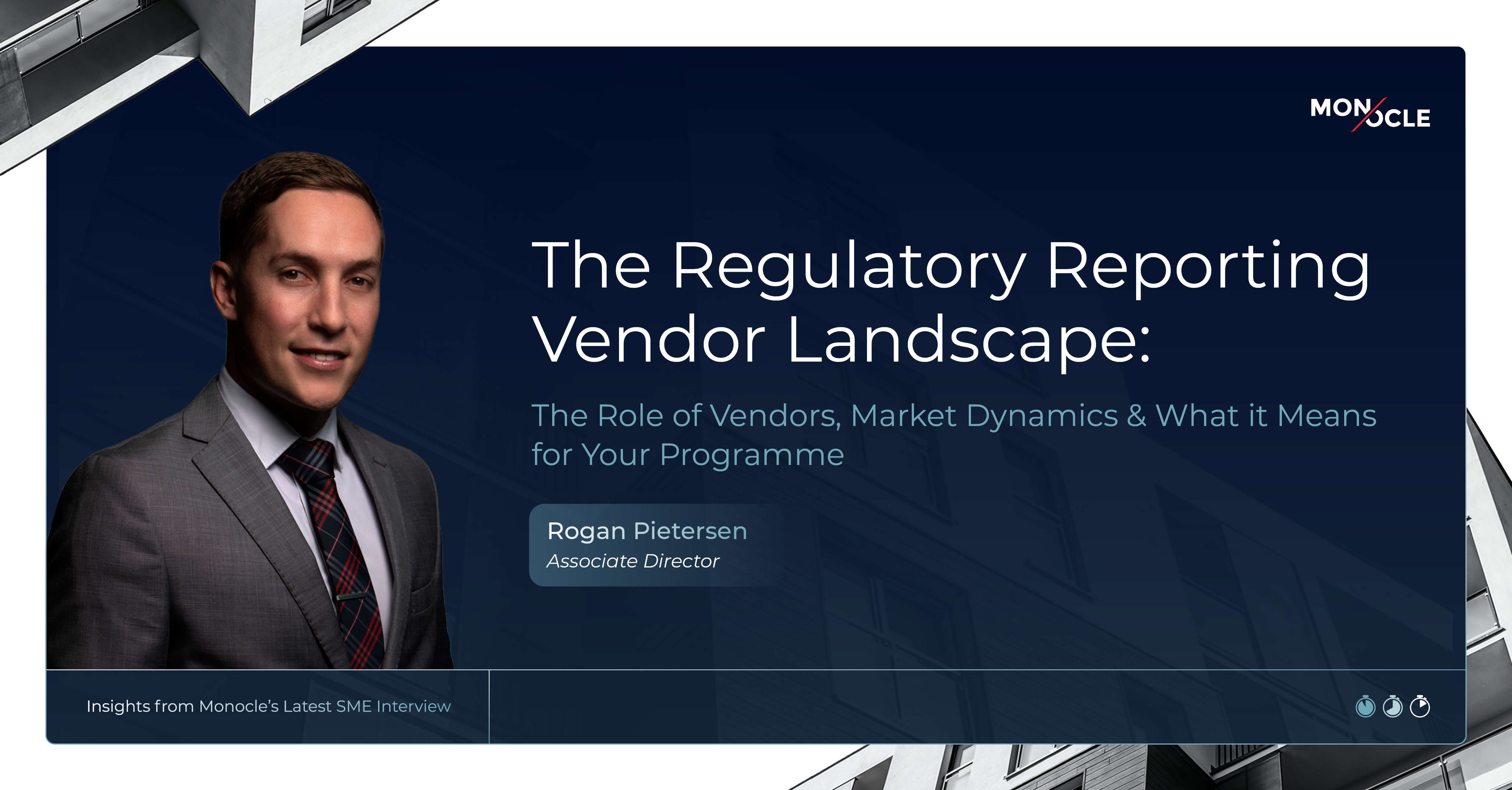
The Regulatory Reporting Vendor Landscape:
The role of Vendors, Market Dynamics & What it Means for Your Programme.
Regulatory reporting tools have long been central to banks’ reporting functions, evolving into sophisticated platforms that underpin robust data management and regulatory compliance. With the vendor landscape undergoing significant consolidation and the Basel 3.1 deadline now less than nine months away, technology choices have become particularly consequential for banks.
We sat down with Rogan Pietersen, Associate Director at Monocle Solutions, to explore what these market shifts mean for banks navigating implementation, how institutions can avoid common pitfalls in platform selection, and why a well-defined data strategy ultimately matters more than the tool itself.
Q: Let’s start with the basics – what role do regulatory reporting vendors play in a bank’s operations, and why have they become such an integral part of how banks manage their regulatory reporting obligations?
Regulatory reporting is one of the more technically demanding and operationally intensive functions within a bank. The volume of data required, the complexity of the calculations, the frequency of submissions and the consequences of getting it wrong means that the stakes are exceptionally high.
What a good regulatory reporting platform provides is an automated, controlled and structured environment, purpose-built for exactly this challenge. The calculation engine, regulatory rules library, submission infrastructure, audit trail, and most critically the ongoing maintenance are fundamental to what makes a regulatory reporting platform truly effective.
Regulations do not stand still, and a vendor's entire business model is built around staying up to date with every rule change, template update and shift in supervisory expectation. This enables a bank to focus on extracting value from its reporting while the vendor is responsible for maintaining the platform’s alignment to reporting templates, standards and requirements set by a variety of regulators.
Q: How has the regulatory reporting landscape evolved over the last few years, and how does where we are today compare to where the market was five years ago?
Regulatory reporting technology has matured considerably as reporting engines have evolved from rigid, rule-based systems into sophisticated platforms with strong data management, configurable calculations and improved analytics. That maturity attracted investment and new entrants, and for a period the market was genuinely competitive with a healthy range of credible vendors offering differentiated propositions across different risk types, jurisdictions and firm sizes.
Recently the regulatory reporting vendor market has become increasingly consolidated amongst a few large platform providers. From a consumer’s perspective, financial institutions reap the benefits of having access to advanced, well supported and complete reporting platforms that scale with their business. However, the recent acquisitions of established reporting platforms have created uncertainty for existing clients regarding the future direction of these platforms, while also increasing external risk such as concentration risk – an issue specifically highlighted under the EU’s Digital Operational Resilience Act.
For technology this critical to financial institutions, it is essential that firms facing this situation have a clear understanding of the future support model for their platform, as well as any planned changes, including potential forced migrations.
Q: The conversation about whether banks should be building in-house reporting capability rather than relying on the vendor market is resurfacing. Is vendor market uncertainty, due to recent vendor consolidation, shifting the thinking for banks on this question?
My view has always been that vendor solutions are the right answer for the vast majority of large banks when it comes to regulatory reporting, and nothing we are seeing in the market has changed that. The appeal of building in-house is understandable - full control, no external dependency, bespoke fit for your own data architecture. But what we consistently observe is that the maintenance burden is relentless.
Regulations change constantly, meaning every rule update requires development resources that are vulnerable to staff turnover and key-man dependencies. What starts as a clean, bespoke solution can gradually become a fragile and costly system that is increasingly difficult to maintain and keep aligned with evolving regulatory reporting requirements.
That said, we recognise that some institutions have the scale, resources, and strategic appetite to make an in-house solution successful and for those banks, it can be the right choice, provided a robust target operating model and effective change management framework are established to support it. The key question, however, is whether the organisation can genuinely commit to sustaining that capability over the long term, not simply building it.
Q: The Basel 3.1 deadline is fast approaching, with substantial reporting amendments. For Heads of Regulatory Reporting who will be fully focused on meeting this deadline, what are key reporting platform considerations as the deadline approaches?
With Basel 3.1 scheduled for implementation on 1 January 2027, banks should already be well advanced in their implementation programmes. Given the limited time remaining, any reporting requirements that cannot yet be met must be identified urgently, prioritised by criticality, and actively remediated. In practice, this often results in financial institutions relying on minimum viable solutions to achieve compliance at go-live.
As a result, a key priority for Heads of Regulatory Reporting will be developing a strategic roadmap to evolve these tactical solutions into a sustainable, long-term reporting capability. It is within this context that the decision between adopting a new vendor platform, within an increasingly consolidated market, or building an in-house solution becomes particularly relevant.
These decisions, however, must be considered alongside the institution’s underlying data landscape. What we always say is to start with your data strategy, not your technology. The most common reason we find banks uncertain about their vendor is not actually the tool itself - it is the data underneath it. No platform, however capable, compensates for a poorly governed, inconsistently sourced data environment. Get clarity on your data architecture and lineage first, and the vendor question becomes considerably clearer. You are looking for a tool that fits your data strategy, integrates cleanly with what you already have, and produces output that your team can run, maintain and explain to a regulator.
Q: For financial institutions that are considering upgrading their regulatory reporting platforms, how is Monocle able to assist them?
Monocle is uniquely positioned to support financial institutions through both vendor selection advisory services and end-to-end implementation expertise for regulatory reporting platforms. By combining practical guidance, business transformation, and technical delivery capabilities, Monocle provides continuity throughout the entire programme lifecycle - from initial assessment and vendor evaluation through to implementation, optimisation, and long-term operating model design.
Monocle provides project management, data, and business analysis capabilities to support programme oversight, data architecture enhancement, process automation, and workflow optimisation. Our deep expertise in data management and governance also enables implementation risks and data quality issues to be identified early through detailed upfront scoping assessments of existing architecture, controls, and reporting processes.
In addition, Monocle has extensive experience in effective stakeholder management across large-scale regulatory and technology transformation programmes. This includes helping institutions mobilise the right stakeholders across finance, risk, and technology, aligning expectations amongst senior leadership groups, and establishing effective governance structures to support decision-making and delivery. This is often critical to ensuring that regulatory reporting transformation programmes maintain momentum, avoid delivery fatigue, and achieve sustainable long-term outcomes.
What's the latest with Monocle
We have all the latest industry insights
Explore trending topics in the banking and insurance industries