

Nederland
Kies een ander land om inhoud te bekijken die specifiek is voor uw locatie


Converging Goals, Diverging Paths:
A Comparative Analysis of the UK, EU and US Basel Reforms.

The United States (US) has finally published its revised Basel Endgame proposal, marking a significant turning point in the global implementation of the Basel III Reforms. While the United Kingdom (UK) and European Union (EU) are broadly aligned in their application of the Basel Committee on Banking Supervision standards, the US has taken a different path, particularly with respect to credit risk, the scope of application, and the roles of internal models. This divergence creates complexity for cross-jurisdictional banks and a level of uncertainty with the US deadline still unconfirmed.
This paper examines these differences across the principal Basel III Reform components - credit risk, operational risk, market risk, and credit valuation adjustment - and considers the practical implications for internationally active banking groups operating across all three jurisdictions.
Basel Reforms As At 2026
The US Basel Endgame has had a notably protracted and contentious development. The Federal Reserve (Fed), Office of the Comptroller of the Currency (OCC), and Federal Deposit Insurance Corporation (FDIC) first published a Notice of Proposed Rulemaking (NPR) in July 2023, setting out sweeping revisions to capital requirements for large banking organisations. The proposal attracted significant industry opposition, with critics arguing that it would materially increase capital requirements and place US banks at a competitive disadvantage relative to international peers.
Following an extended consultation period and sustained industry engagement, the agencies issued a revised Notice in March 2026. The revised proposal represents a substantial recalibration: it removes a number of overlapping requirements, narrows the scope of application, and more closely aligns capital outcomes with underlying risk. In contrast to the UK and EU approaches, both of which are generally expected to increase aggregate capital requirements under their own Basel Reforms, the US agencies stated that the revised proposal would, in aggregate, modestly reduce capital requirements for the largest US banks.
Notwithstanding these differences, all three jurisdictions are implementing the standards developed by the Basel Committee on Banking Supervision and share the same overarching objectives: to improve risk sensitivity, enhance comparability across institutions, and address broader systemic risk considerations. However, material divergences have emerged in implementation design, scope of application, transitional arrangements, and expected capital impacts.
Implementation timelines also differ materially. In the United States, the consultation on the revised NPR closes in June 2026, and implementation dates will be determined following publication of the final rule.
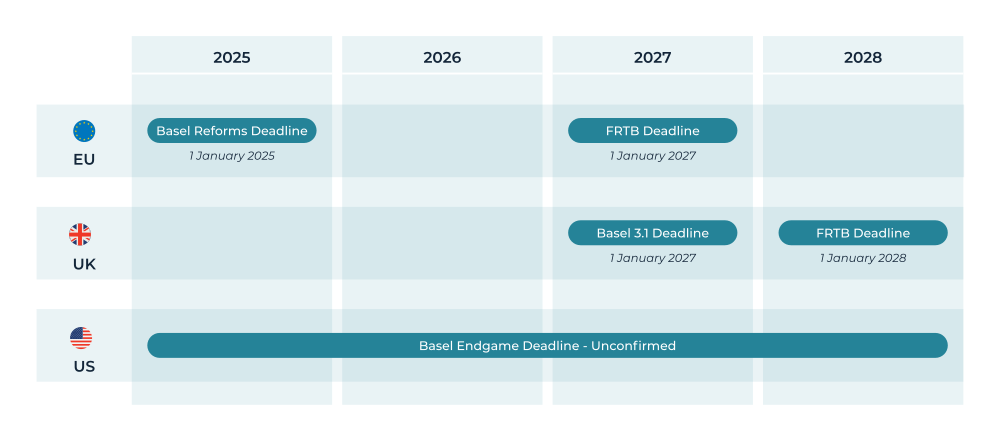
With the three regimes aligning and diverging across multiple components of the Basel III Reforms, this paper highlights key implementation considerations across the following:
Scope of application: Tiered versus uniform approaches to determining which firms are in scope.
Credit risk: Permitted methodologies, role of internal models, and approach to risk weight determination.
Operational risk: Design of the Business Indicator framework and treatment of historical losses.
Market risk: FRTB calibration, application thresholds, and implementation timing.
CVA risk: Scope of application and treatment of counterparty exemptions.
Regulatory philosophy and capital impact: Underlying policy choices and the resulting effect on RWAs and capital requirements.
Transitional arrangements and strategic implications: Phase-in timelines, jurisdiction-specific reliefs, and the challenges for internationally active banks.
Scope of Applicability
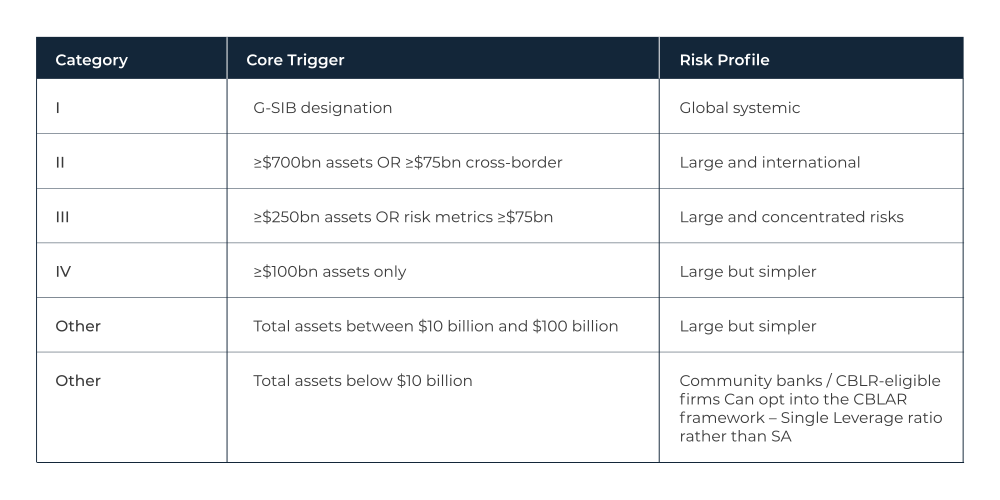
A major point of divergence between the US and the UK and EU Basel III Reforms frameworks is the scope of application. In the US, prudential requirements are applied using a tiered framework comprising four regulatory categories, determined primarily by asset size, cross-border activity, and systemic importance. As summarised in the table below, Category I and II banking organisations, the largest and most systemically important firms, would be subject to the most comprehensive requirements under the proposed Expanded Risk-Based Approach (ERBA), while Category III and IV firms would remain subject to a revised Standardised Approach.
“Material divergences have emerged in implementation design, scope of application, transitional arrangements, and expected capital impacts.”
United States Category Breakdown
In contrast, the UK and EU apply their Basel III Reforms more uniformly across the banking sector, with requirements determined principally by the nature of a firm’s activities rather than through a formal categorisation framework based on size and systemic importance. Subject to supervisory approval where relevant, firms may apply the approaches that are appropriate to their business model and risk profile, including the continued use of internal models in areas where these remain permitted.
The revised US proposal also recalibrates the methodology used to determine the global systemically important bank (G-Sib) surcharge. The changes are intended to improve risk sensitivity and better reflect structural developments in the financial system since the framework was first introduced. By reducing the volatility of annual surcharge outcomes and aligning scores more closely with each firm’s underlying systemic footprint, the proposal is expected to result in modest reductions in G-Sib surcharges for some Category I and II firms, although the impact will vary depending on each institution’s indicator profile and resulting method score.
Calculation Frameworks
The differences between the US, UK and EU frameworks become more pronounced when comparing the detailed treatment of credit risk, operational risk, market risk, and credit valuation adjustment (CVA). The UK and EU rulesets are broadly aligned across these risk categories, reflecting a common interpretation of the Basel Committee on Banking Supervision’s standards, and enforce similar policy choices regarding scope and calibration. The US has moved closer to the UK and EU in operational risk, market risk, and CVA by adopting methodologies that are structurally consistent with the Basel 3.1 framework, albeit with important differences in application thresholds, implementation mechanics, and calibration.
Credit Risk
Credit risk represents the most significant point of divergence. While the UK and EU retain a framework that continues to permit the Internal Ratings-Based (IRB) approach for certain asset classes, subject to the Basel 3.1 output floor, the US proposal relies exclusively on standardised methodologies for calculating credit risk capital. As a result, credit risk is the area in which the US has taken the most distinct structural approach, with potentially significant implications for capital outcomes and for internationally active banks seeking to reconcile regulatory requirements across jurisdictions.
Moreover, the US standardised framework differs materially from the UK and EU approach in how risk weights are assigned. Rather than relying on external credit ratings under the External Credit Risk Assessment Approach (ECRA), the proposal uses a supervisory grading methodology based on a bank’s internal assessment of obligor creditworthiness, supported by key financial ratios and qualitative indicators of solvency. This approach closely resembles the Standardised Credit Risk Assessment Approach (SCRA) introduced under Basel 3.1 and applied in the UK and EU to unrated bank exposures.
As a result, SCRA-type data and analytical capabilities are becoming increasingly important across all three jurisdictions, while the role of external ratings is diminishing, particularly in the United States, where ECRAbased data is no longer required for regulatory capital purposes. The operational challenges that UK and EU firms have encountered in sourcing and maintaining the financial and qualitative information needed to assign SCRA grades to unrated institutions are therefore likely to be amplified for US banks, given that comparable supervisory assessments will apply across a much broader range of corporate and financial institution exposures. For internationally active banks operating across jurisdictions, the practical implication is the need to operate fundamentally different credit risk frameworks in parallel. As such, banks with large portfolios of unrated corporates and financial institutions are likely to experience the most pronounced divergence in risk-weighted assets and capital requirements across jurisdictions.
Operational Risk
Operational risk is one of the areas where the United States proposal converges most closely with the UK and EU Basel III Reforms frameworks. Across all three jurisdictions, internal model-based approaches are being eliminated and replaced with methodologies based on the Business Indicator, consistent with the Basel Standardised Measurement Approach (SMA).
For Category I and II firms, the United States introduces a BI-based methodology that is conceptually similar to the UK and EU approach, but with several important simplifications. The framework retains the Interest, Lease and Dividend Component (ILDC), while consolidating the remaining BI components into a single Non-Interest Component. Unlike the UK approach, the US proposal does not include an explicit loss-based adjustment. This is broadly consistent with the European Union and the United Kingdom implementation, where the Internal Loss Multiplier (ILM) is set to 1 for all institutions, effectively neutralising its impact on capital requirements. By contrast, the United Kingdom retains the full ILM framework.
For Category III and IV firms, the United States does not require a separate operational risk capital charge. Instead, operational risk is reflected indirectly within the broader standardised capital risk weights. This represents a significant departure from the UK and EU regimes, where a standalone operational risk charge applies across the banking sector regardless of institution size.
Market Risk
In market risk, the UK and EU have both adopted, but not yet implemented, the full FRTB framework, preserving the Basel hierarchy of a Standardised Approach and, subject to supervisory approval, the use of IMA. The two regimes are substantively aligned, with the principal distinction being implementation timing. The UK has deferred the application of FRTB-IMA until 1 January 2028, citing the need for international alignment and reducing the operational burden for firms that would otherwise need to maintain overlapping market risk frameworks across jurisdictions.
The United States proposal is also closely aligned to the UK and EU but, proposes several US specific modifications. It introduces a revised standardised measure, and an updated model-based framework built around expected shortfall and more granular risk factor calibrations. A notable feature of the US proposal is the cap on the model-based non-default capital requirement (NDCR), which places an upper limit on market risk capital generated by internal models and mitigates the risk of excessively conservative outcomes. By contrast, the UK and EU rely on the Basel 3.1 output floor at the total risk-weighted asset level, which constrains model-driven reductions in aggregate capital but requires firms to maintain parallel standardised and model-based calculations.
The US framework applies the revised framework to Category I and II firms and banking organisations with significant trading activity. Importantly, the threshold for mandatory application has been increased from $1 billion to $5 billion of trading assets and liabilities, materially narrowing the population of firms subject to dedicated market risk capital requirements. For institutions below this threshold, trading exposures are expected to be sufficiently capitalised under the credit risk framework, reducing implementation complexity and potentially lowering overall compliance costs.
Credit Valuation Adjustment (CVA)
A similar pattern is evident in CVA risk. The US, UK and EU have each adopted CVA capital frameworks that are broadly aligned with the Basel 3.1 standard. These frameworks comprise of two Basic Approaches, distinguishing between hedged and unhedged portfolios, and a Standardised CVA approach, with largely consistent underlying methodologies and risk sensitivities.
The principal difference lies in the scope of application. In the US, the revised CVA framework applies only to Category I and II banking organisations and to firms with aggregate over-the-counter (OTC) derivatives gross notional amounts of at least $1 trillion. As a result, only the largest and most derivatives-intensive institutions will be subject to a standalone CVA capital requirement. Smaller firms will continue to capture counterparty credit and valuation risks through other elements of the capital framework.
At the transaction level, the UK and US frameworks are closely aligned with the Basel standard. The United Kingdom has removed the exemptions previously available to exposures to non-financial corporates and pension funds under Basel 3, bringing a broader population of derivative transactions into scope for CVA capital. The European Union, by contrast, has chosen to retain these exemptions under CRR3 as an explicit policy departure, citing concerns regarding the availability and cost of hedging instruments for non-financial counterparties. Consequently, UK firms may experience materially higher CVA capital requirements than their EU peers, even where underlying derivatives portfolios are otherwise similar.
Impacts and Considerations
The US has adopted a more standardised and simplified framework. The revised Basel Endgame proposal removes internal models entirely for credit and operational risk, consolidates requirements for the largest firms within the Expanded Risk-Based Approach, and anchors capital outcomes to supervisory standardised methodologies. Internal models are retained only for selected elements of market risk. This approach is explicitly designed to reduce complexity, improve comparability of capital ratios, and limit variability in model-derived risk-weighted assets (RWA).
“The divergence across the US, UK and EU regimes reflects fundamentally different regulatory philosophies.”
By contrast, the UK and EU have retained a model-inclusive approach in which internal models continue to play a central role, subject to the Basel 3.1 output floor. This preserves greater risk sensitivity and allows capital requirements to reflect portfolio-specific characteristics, while constraining the extent to which model outputs can reduce regulatory capital. Both jurisdictions are phasing the output floor to 72.5% by 2030. The European Union has introduced additional transitional relief through 2032 for selected exposure classes, including unrated corporates, low-risk residential mortgages, and certain derivatives exposures, thereby moderating the near-term capital impact relative to the United Kingdom.
These design choices have materially different capital implications. In the UK and EU, the combination of the output floor, revised credit risk treatments, and new operational risk requirements is expected to increase RWA for many institutions, particularly those that have historically benefited from lower internal model outputs. In the United States, the March 2026 revised proposal marks a significant change in direction: the agencies indicated that the package would, in aggregate, modestly reduce capital requirements for the largest banks and moderately reduce requirements for smaller affected firms.
For internationally active banking groups, the resulting landscape is highly complex. Firms must navigate fundamentally different methodologies, varying scopes of application, staggered implementation timelines, and potentially opposing capital impacts. Managing this environment requires more than technical compliance; it demands a strategic understanding of where capital is likely to be consumed, released, and constrained across jurisdictions.
“For internationally active banking groups, the resulting landscape is highly complex. Firms must navigate fundamentally different methodologies, varying scopes of application, staggered implementation timelines, and potentially opposing capital impacts.”
How Monocle Can Assist?
Since the adoption of Basel II 20 years ago, Monocle has assisted our banking clients across Europe, the United Kingdom and South Africa in implementing and embedding their end-to-end regulatory capital solutions. Monocle’s regulatory capital consulting roles span data modellers and analysts, process engineers, business analysts and programme implementation leads.
Our implementation expertise includes designing fit-for-purpose regulatory data models; building and upgrading in-house calculation engines, or configuring and integrating vendor solutions, to run IMA and standardised approaches in parallel for output-floor comparability; conducting process auditing to vet data quality and the validity of regulatory capital results; and designing and building external regulatory reporting, business intelligence visualisations and management information dashboards.
With the United Kingdom implementation date approaching and the United States consultation closing in June 2026, the time available for preparation is narrowing, and Monocle is well positioned to help banks move from regulatory interpretation through to embedded, automated, audit-ready Basel IV capabilities, rather than relying on tactical workarounds at go-live.
What’s the latest with Monocle
We have all the latest industry insights
Explore trending topics in the banking and insurance industries